4G/5G in a box - experiences

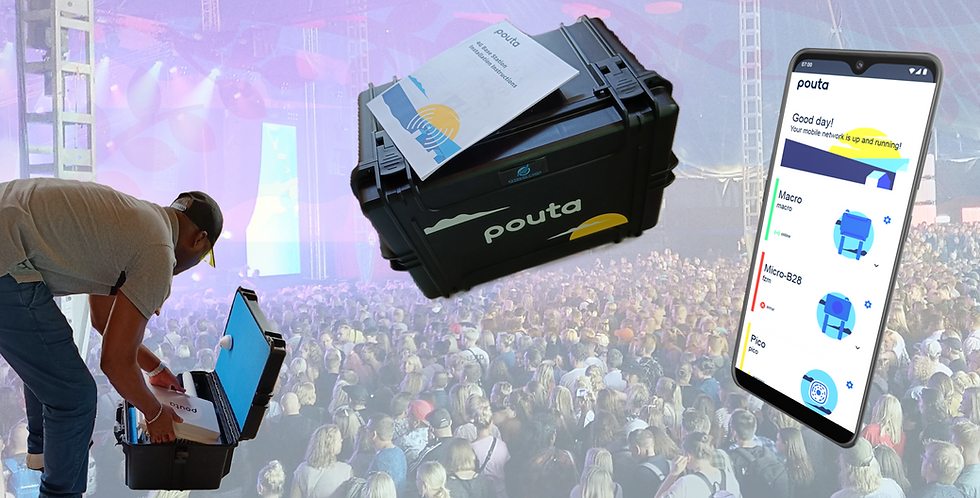
For more than five years Poutanet has been renting 4G network-in-a-box solutions. Late 2025 the first rental contract for a 5G network was made. What are these networks used for and why is private mobile the technology of choice?
Events and festivals with 4G now and 5G coming
For years now big events such as music festivals with digital payments have been the most obvious and successful use cases for the Poutanet network-in-a-box solution. Also, in smaller events such as orienteering events organized in rural environments or other areas where public mobile networks do not have the spare capacity to serve a large crowd private mobile comes in handy. Building a wired or Wifi infrastructure for covering the large event areas for just a few days is a daunting and costly job.
So far, the bread-and-butter business for private mobile has been digital payments, but with increasing security requirements also the interest in connecting surveillance cameras and other security equipment is growing. Traditionally security equipment is connected using Wifi, which requires a lot of work and is unfortunately quite unreliable. In a festival crowd you can expect quite many smartphones to have Wifi tethering activated – meaning there is interference on the unlicensed bands. Obviously, it is quite easy for bad actors to purposefully interfere with selected camera installations.
The killer use case for private 5G at events is wireless camera crews for media – especial those sending live. Alternative networking solutions are not reliable. Public mobile networks are crowded and Wifi comes with the risk of interference – especially if more than one media crew is present.
Remote control of utility vehicles using a network-in-a-box
For cranes in harbors and factories permanent private mobile deployments are the choice. Autonomous busses operate in areas with good public mobile coverage, but devices moving off-road need to bring connectivity along. The topic is not new. Already before COVID times the Poutanet team helped equip an autonomous warrior with a 4G network that allowed the control of unmanned ground vehicle (UGV) from safe distance using a tablet.
If you are in the forestry business controlling a harvester that is roaming the trackless terrain from a game studio placed along the roadside is quite an attractive option. No steep ups and downs, no constant noise – just a regular game controller and a few large screens. But how do you connect to the machine? In rural forested areas you most likely get a signal from one or two of the mobile operators, but for a safe operation of the harvester you need several high-quality video streams. In forests the needed capacity is rarely available. Satellite services – a clear no-go, as there is no sky view. Wifi is not that great as the allowed 100 mW of transmit power is easily absorbed by the next bushes. Private mobile to the rescue!
As already mentioned, the bulk of the traffic between the roadside game studio and the forestry machine is video needed for safe operations. The amount of control traffic is negligible. If the network-in-a-box is 4G, it is a good idea to mount the whole private network on the forestry machine and to use a mobile router at the game studio. With this setup you can use the downlink for the heavy video traffic. With the mid-band TDD frequencies available for private 4G this means you get more than three times the capacity for video than you would using the uplink (even with an uplink heavy configuration). This is great, as radio propagation in the forest is far from optimal and as the machine moves further from the controller the base station soon asks more robust codecs to be used – which reduces the throughput significantly. The extra capacity means range.
Development and testing involving 4G and/or 4G
What comes to radio propagation and coverage in difficult environments the proof of the pudding is in the eating. In an industrial environment such as a steel mill theoretical radio planning for private mobile is notoriously difficult and needs change over time. A portable network-in-a-box is simple and cost-efficient way to test how where to put that additional base station for getting a signal to some newly installed sensors or for closing observed coverage gaps.
Another use case is testing of connected solutions e.g., for military or dual use purposes. When hooked to a public mobile network it is difficult to test changing connection qualities or different network settings. Today this is mostly a 5G topic. The most recent testing was done for the Carewings-5G EU project, where the switching of user equipment between a private network and the public Virve 2 service had to be tested before the actual 5G network at Pyhtää was fully operational.
4G/5G network-in-a-box: cheaper than a daily restaurant meal
Private mobile does not have to be expensive. Poutanet network-in-a-box solutions are available starting 1350€ per month. That is 45€ per day. The only additional mandatory cost is the frequency license. In Finland 20 MHz of B40 from Traficom adds a bit more than 3€ per day to the bill. Not much for having a network and frequency all to yourself.


Comments