Social ISPs: Ranting at Regulators

Updated: Jun 4

I was asked to give a short presentation to a large group of telecom regulators and other senior folks from related organizations from Asia and Africa.
What other speakers saw as an opportunity to pitch their companies I used for ranting about regulatory shortcomings that should be addressed in order to make our award winning (three so far) Social ISP concept fly – or at least legal.
The Social ISP: How communities and 3rd sector actors can fill gaps of the mobile networking ecosystem
During covid, our Fusion Grid research project deployed off‑grid solar and connectivity to a small community in Namibia. Five households. No engineers. No technicians. No site visits. They ran the system themselves. They did upgrades. They rebooted components. They kept it alive – not because our project planned to do so, but because of the lockdowns – and because the community very much valued connectivity and electricity.
All they needed was remote support which was provided using regular tools like WhatsApp as well as remote access to the computers and controllers of the system. The latter allowed adding features such as electricity quotas when growing electricity consumption was exceeding the battery capacity and a dedicated Wifi service for the kids who had to practice remote education because of covid.
From that experience we created the Social ISP model — low‑cost local 4G networks operated by NGOs, schools, or communities. Wi‑Fi on steroids. MiFi devices feeding legacy phones. Affordable. Scalable. Award‑winning. IEEE and USAID think it is worth rewarding. Regulators could too — if they wanted to.
Building and operating a simple private 4G network does not have to be more complicated than maintaining your own Wifi. The big difference is the reach. With a single small cell base-station you can cover a whole village. Building Wifi means you have tens of access points – which all need power and some protection and create a complex structure that results in a significant maintenance effort.
So far, the biggest blocker for Social ISPs has been the national telecom regulations, that makes the use of 3GPP technology difficult unless you are a fully licensed telco.
This is my reason for ranting and we see the world changing. We have seen the first constructive approach which should allow a non-profit organization to start Social ISP activities soon. Once the ink of the signatures and stamps dries, I will write more about how to manoeuvre the bureaucracy.
Misery created by good intentions
Now let’s focus on the obstacles that years of good telco regulation have created!
National or regional frequency licenses almost always come with a 70% - 80% population coverage requirement and a build obligation for 24 months. This has been common practice since the introduction of commercial mobile networks – and for some good reasons.
In the 1990s a frequency suitable for mobile networks was considered a license to print money. You could become rich either by building a network and serving customers that were lining up for their first mobile service ever – or you could hoard the frequency and sell it later at significantly higher price. Regulators had to create rules for making hoarding difficult and for discarding applicants that would be likely to fail when trying to build the network. Build obligations did just that. As an upside there were the economic benefits of bringing mobile service to the big cities first. It is good to note that the playing field was reasonably level, as almost all players were raising their firsts towers.
Fast‑forward 30 years...
With a crowd of regulators in the room I asked if anyone had moved at least partly from build obligations to something else. None.
Congratulations! You’ve successfully built a system where the only serious players left are the same three MNOs who already own all the towers, all the backhaul, and all the political influence. The same three companies take up every new frequency that is licensed and build the required population coverage. In large parts of the world the connectivity gap between well covered and uncovered remains untouched.
Typically, the remaining 20%-30% of the population is spread across the majority of the country's landmass (rural villages, mountains etc.) in areas where fiber connections, ready-made masts, power supply and other infrastructure is not available. A 404 error when looking for a business case - except in countries where the price tag for mobile services is so high that it is profitable to go after the remaining potential users or the occasional tourists.
For any new market entrants, the buildout requirements make life extremely hard. They do not have the towers and backhaul connections but need to rent or build the infrastructure. In the last ten years Jio, Iliad and Rakuten have succeeded. On a planet with 195 countries that is not too many.
Temporary Capacity? Sure… if you have time and money
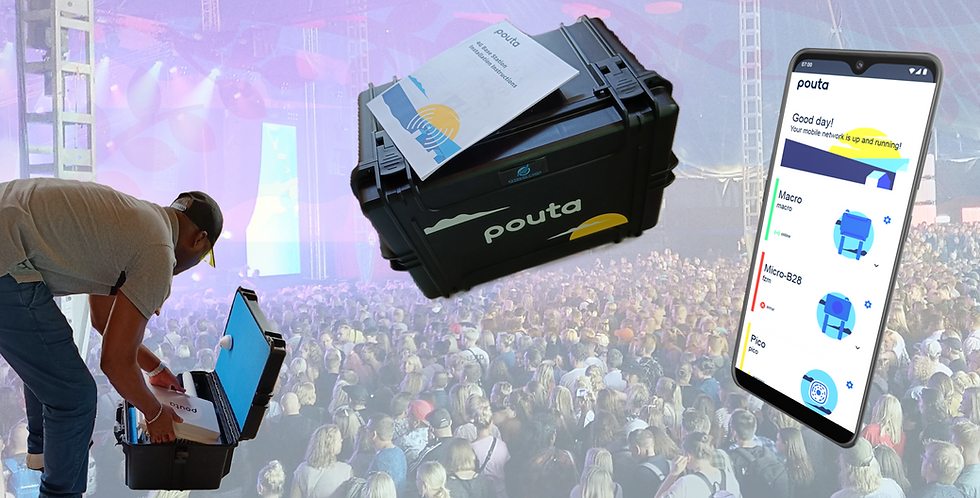
Festivals. Tens of thousands of people. For a mobile operator it should be easy to add temporary capacity. They have cells on wheels and transport infrastructure – but wait, there are rules and processes. If you extend the public telecom network the regular KPIs apply. Seamless mobility needs to be configured, otherwise you will see dropped calls and the regulator will come after you. This means running a well exercised process with planning, implementation and testing and a small army of engineers involved. All this for a few days of extra traffic.
This is how the system was designed to work. Complexity is a feature, not a bug.
Obviously, much of the extra capacity at a festival can be used by the visiting guests, but those who starve unless they are served are payment terminals and other applications used for running the show at the festival. Those use cases are currently better served with a temporary private network – which does not need much planning or seamless handovers.
Let Satellites Fix It! — The Elon way of thinking
Non-terrestrial-networks (NTN) have been a hot topic in telecom since Starlink started their service five years ago and proved that low orbit satellites can provide a decent data service. At the first glance it seems that NTN is the holy grail for closing the digital divide. Satellite services can cover oceans and deserts. It does not matter that spectral efficiency is lousy – as subscriber densities are low. The next big thing is direct-to-device, satellites serving regular mobile handsets just like regular base stations.
There are however a few obstacles. A Starlink subscription is affordable for a safari lodge serving rich tourists but definitely not for a rural household in developing economies. Direct‑to‑device is great, but it requires fresh 4G phones with capabilities that most rural users will not have in the next years. It is also good to note that the data rates provided are very low according to current expectations. Messaging only is likely to be a bit of a disappointment. Also, it is fair to assume that living in rural areas does not mean that mobile devices are used preferably outdoors. Indoor coverage is a problem for satellites that fly over the users. For radio waves solid roof structures are hard to penetrate. For regular base stations sitting on a tower life is easier as distances are shorter and buildings tend to have windows (and often walls) that cause much less attenuation than solid roofs. While Santa Claus may come from chimneys radio waves do not. So, looking at the sky does not fix the problems created by 30 years of more of the same.
Meanwhile Europe and the US found solutions that could solve problems elsewhere too
Regulators made some spectrum cheap and easy to access. Local frequency licenses (in at least 15 European countries now) and CBRS shared but coordinated spectrum (US) have made it possible to use private mobile for a wide variety of use cases including temporary networks.
In many ways the EU and USA have been great incubation areas for smaller private mobile players. A large market area with free movement of goods is almost as important as the availability of licensed frequencies. We rented base stations for a festival is Spain where extra capacity was needed at very short notice. Shipment times can be counted in hours, not days or weeks. On the other hand, delivering a complete private network to a customer in the Middle East turned out to be impossible as no legal way for importing the kit could be found.
Import licenses, resale licenses, local type approval and homologation requirements create effective trade barriers that by design or by accident protect the established mobile network ecosystem where large roll-out projects planned well in advance make it possible and economically feasible to master the costly and time-consuming bureaucratic agility course. This is a bit sad as 3GPP standards and standards compliant products are the same all over the world.
Now you may point out that festival networks for payment terminals, 5G powered TV camera crews and other more dynamic private mobile use case are solutions for first world problems that are less relevant in other parts of the world.
But then again – community hosted simple small private mobile networks provide an excellent way to solve the last mile problem for those currently out of coverage. For that we have been promoting the Social ISP model which after winning several academic awards is now being put in practice.
Thank you for reading about my rant.
If you’re a regulator and you feel slightly uncomfortable — good. That means you’re paying attention.
If you’d like to help fix the situation, we’re ready. If not… well, enjoy the oligopoly you’ve spent 30 years perfecting.
/Heikki
Social ISP links
Social ISP for Reducing Digital Inequality (IST Africa 2025) https://ieeexplore.ieee.org/document/11060058
IEEE CTU awards (Gender Inclusion, business model concept): https://ctu.ieee.org/challenge/2023-ctu-challenge-2/
An earlier version of this blog is available at https://www.linkedin.com/pulse/social-isps-ranting-regulators-heikki-almay-zk8jf/


Comments