Developing Poutanet AI Assistant with the LUMI Supercomputer

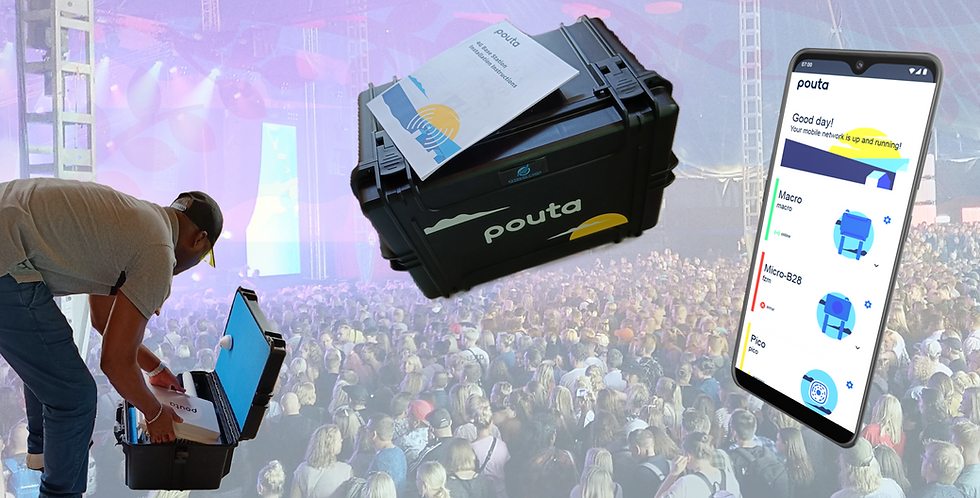
Increasingly private 4G and 5G networks are deployed in high-demand environments such as live event venues or emergency response operations. In these deployments it is essential that all functionality is deployed locally. This includes any use of AI. If the backhaul is not working, you cannot get advice on how to fix it from a cloud deployed model. This is the world where Poutanet lives day in and day out. Our Sunshine management platform was created just with this in mind.
To further simplify operations and accelerate issue resolution, we have been developing an AI-powered troubleshooting assistant as a companion for our Sunshine management platform.
When testing openly available Large Language Models (LLMs), we found that these modes are surprisingly good in their advice but still have clear gaps in deep, domain-specific telecom troubleshooting. Simply adding retrieval augmented genearation (RAG) with product and domain documentation wasn't enough. We set out to test if fine-tuning models directly on our proprietary materials and technical data would improve this.
Through the LUMI AI Factory and its Try & Buy program, we gained access to LUMI’s high-performance AMD GPU infrastructure alongside expert support and training.
It took just two days to develop the needed fine-tuning code and get it running on LUMI supercomputer. And the starting point was virtually zero. Basically, one weekend. LLMs still do struggle a bit and hallucinate as apparently, they do not have same amount of training data on European supercomputers but just keep going and you will get there. And hallucinations are actually a great way to supercharge learning – just ask you coding agent or chatbot what does this or that command actually does and why it failed! We also found the overly optimistic nature of chatbots motivating. Nothing works from time to time but they are over the moon. Somehow that fits the Finnish mindscape.
The biggest benefit for using supercomputers like LUMI is that you are no longer limited by hardware but just the capability to collect, validate or generate and clean data. This means more iterations in fine-tuning leading to better results. One unexpected challenge has been the rapid development and improvements as new models seem to be dropping also on weekly basis.
We are currently running internal live validations with two prototype variants designed to handle technical support queries and streamline network setup. Initial results are very promising for reducing resolution times and user cognitive load.
Our next milestone is a production pilot planned for autumn 2026, where we will test the assistant in real operational environments.
Finally: a big thank you to Liisa Haltia, Mikko Kerttula and the whole CSC / LUMI AI Factory team for supporting our project and featuring our journey on CSC blog
👉 Read the full CSC feature article: Poutanet advances 4G and 5G telecom innovation using LUMI AI Factory Services


Comments